Jupiter’s moon Europa may have a habitable ice shell
Deep beneath the thick iceshell, there is a saltwater sea on Jupiter’s moon Europa. New research has revealed that Europa’s ocean may be habitable.
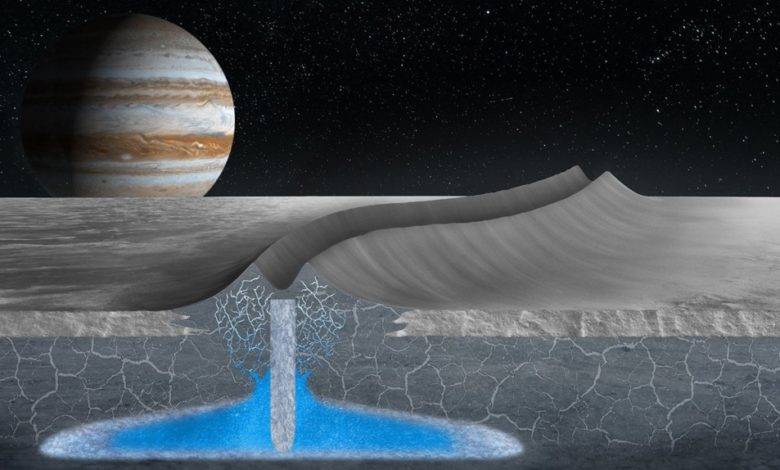
For more than 20 years scientists have been fascinated by the dramatic gashes found on Europa’s icy surface. These double ridges can rise to almost 1,000 feet (305m) in height, with large valleys between them. Although these features were first spotted by NASA Galileo’s spacecraft in 1990, researchers have not been able to identify how they formed.
Researchers observed a similar double-ridge feature, similar to the letter M, while studying the Greenland glacier using ice penetrating radar observations. This is a miniversion from the one seen on Europa.
The journal Nature Communications published Tuesday a study detailing these findings.
WATER’S IMPACT ON ICE SHEET TOPOGRAPHY
Researchers use drones to observe changes in the ice sheets of the polar regions. This can help them determine how these could affect the global sea level. These instruments are able to spot ponds of meltwater and conduits with seasonal drainage, as well as subglacial lakes.
“We were working in a completely different area related to climate change. And its impact on Greenland’s surface when we noticed these tiny double-ridges. And we were able see the ridges move from ‘not formed’ into ‘formed. said study senior author Dustin Schroeder, an associate professor of geophysics at Stanford University’s School of Earth, Energy & Environmental Sciences, in a statement.
Operation IceBridge was a NASA mission which collected radar data and surface elevations of the icesheet between 2015-2017. It revealed that Greenland’s double Ridge formed after the Ice Sheet had fractured around water. The distinct peaks were created by the pressure in the water pocket.
Researchers wondered if it was possible to do the same on Europa. Under the ice shell, there could be pockets of water that could create potentially habitable environments.
“In Greenland this double ridge was formed at a point where water from surface streams and lakes often drains into the nearsurface and refreezes.” saidStatement by Riley Culberg, a Stanford doctoral student in electric engineering, as the lead author of the study.
“One possibility for similar shallow water pockets to form on Europa could be water from the subsurface ocean being forced upwards into the iceshell via fractures. That would suggest that there could be some exchange going on inside the iceshell.
AN EVER-CHANGING LUNAR SURFACE
Europa seems to be a dynamic location, with plumes of water rising up through cracks in the thick ice shell. This ice shell could also be a place where nutrients and subsurface ocean mix.
Schroeder stated, “Because they’re closer to the ground, where you get intriguing chemicals from space, other lunars and the volcanics of Io (another Moon that orbits Jupiter), there is a possibility that there’s life if there are pockets water in the shell.” said. “If the mechanism that we see in Greenland is what these things happen on Europa it suggests there’s water everywhere.”
It was the first time scientists could observe something like this on Earth. They were also able to observe the subsurface processes that lead to the formations of Culberg’s Ridges. said.
Schroeder: “The mechanism we proposed in this paper would be almost too bold and complex to propose without seeing it actually happen in Greenland.” said.
The team may be able to use the vast data they have already collected on Greenland’s Ice Sheet as an analog for future dynamic processes on Europa.
Europa’s temperature, chemistry, and pressure are very different from Greenland. The team is interested in investigating how these water pockets function on Europa.
Europa will be the target of two missions in the future, JUICE from the European Space Agency (short for Jupiter Icy Moons Explorer), and NASA’s Europa Clipper. Clipper will have an ice penetrating radar to capture subsurface images of Europa’s Ice Shell, much like the Greenland researchers did.
Europa is a prime candidate for extraterrestrial life within our solar system. This is due to the subsurface ocean’s liquid water and what scientists know about its chemistry, Culberg said.
SourceCTV